



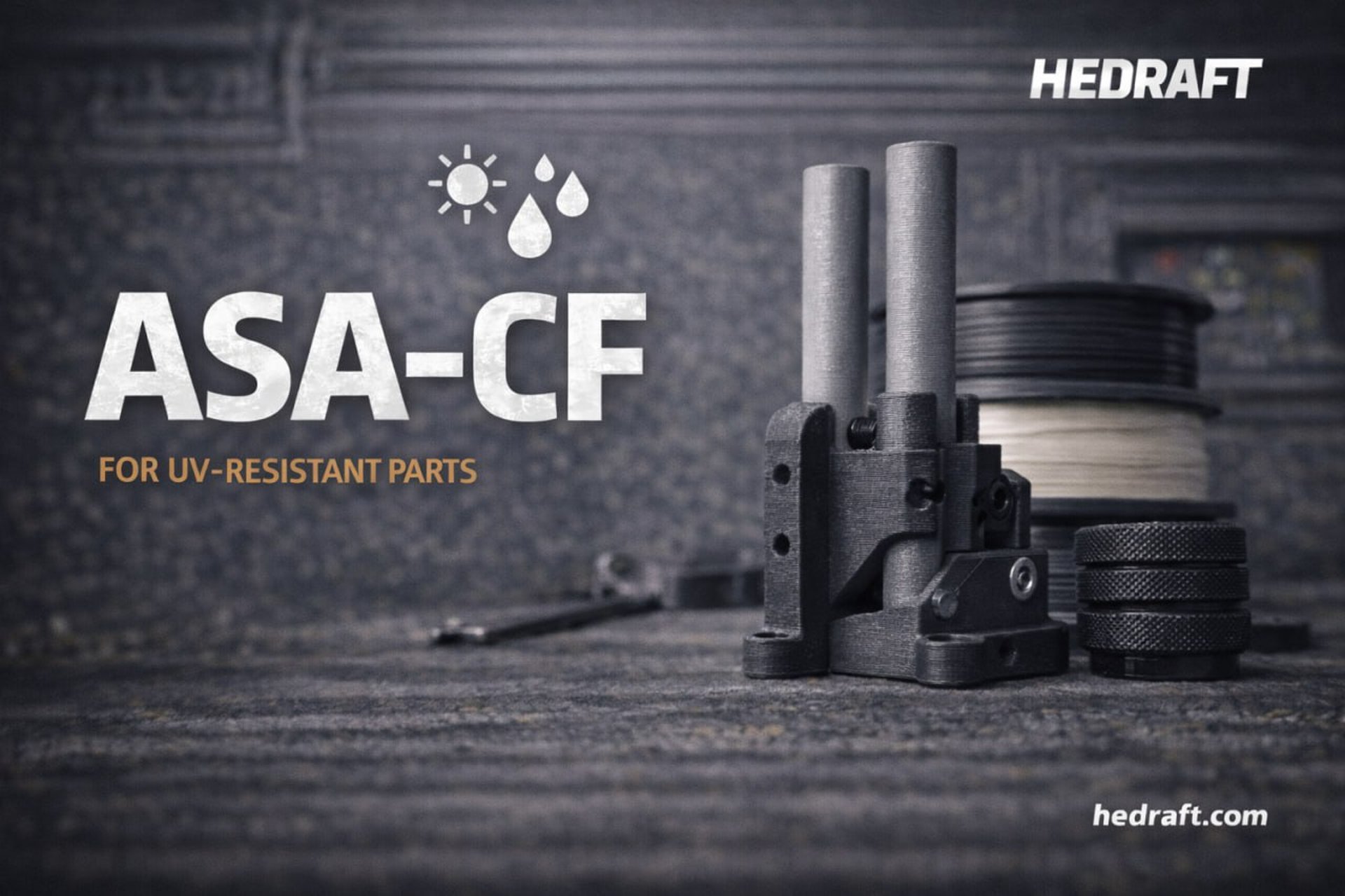
ASA-CF
ASA-CF is a composite material based on ASA with added carbon fiber. It retains the main advantages of ASA for outdoor use (UV and weather resistance), but provides a stiffer part and more stable geometry. At HEDRAFT, we use ASA-CF for fasteners intended for outdoor use, structural components and parts for which standard ASA is too soft.
ASA-CF — street + rigidity + stable geometry
ASA-CF is the choice for outdoor components where both UV resistance and rigidity are important. The material is well suited for fasteners and structural components that must retain their shape and not "play" outdoors.
Where does ASA-CF fit in?
Outdoor brackets and mounts (rigid, geometric)
Outdoor enclosures and casings where form and stability are important
Structural elements (posts, ribs, supports) for outdoor conditions
Parts for assembly/connection outside (if accuracy is required)
Outdoor technical units (at normal temperature)
Projects with wind/vibration loads (depending on the task)
Outdoor parts series where dimensional repeatability is important
When ASA-CF is not the best choice
Strong impacts/drops – sometimes regular ASA or PETG (more viscous) is better.
High temperatures near heating – consider ABS/PAHT-CF.
Maximum mechanical load and wear – PA/PAHT-CF.
Flexibility/cushioning required – TPU.
Need to get the perfect "showcase" look - PLA is often easier to use (if not exposed to outdoor/stressful conditions).
Why choose ASA-CF?
UV resistance and weather stability (similar to ASA)
Higher rigidity (carbon fiber)
Stable geometry: less movement of the part shape
Good repeatability for mass-produced outdoor applications
Technical matte finish (often has a "high-end technical" look)
What we need to know before printing ASA-CF
Conditions: Outdoors/under cover/in a box, direct sunlight
Load: Wind/vibration/static
Impact loads (important when choosing CF/non-CF)
Are tolerances/tolerances required?
Operating temperature (if there is a hot place nearby, choose another material)
Are metal inserts/pins required for fastening?
Examples of ASA-CF products
Sturdy outdoor brackets and mounts
Outdoor enclosures for equipment/sensors
Structural components and supports
Manufacturing parts for use in sunlight and weather conditions
Frequently asked questions:
Is ASA-CF better than regular ASA?
For street parts where rigidity and stable geometry are essential, ASA-CF is often a better choice. Where impact resistance is more important, regular ASA is sometimes better.
Is ASA-CF suitable for outdoor use and in the sun?
What to choose for outdoor use: ASA, ASA-CF or PETG?
Is ASA-CF more fragile than ASA?
Is ASA-CF suitable for precision assembly parts?
ASA is the standard for outdoor use. Where rigidity and geometry are required, ASA-CF is used. Where the part is intended for indoor use or without UV exposure, PETG is often used.
Often yes, because composites provide more stable geometry. But we still calculate tolerances for a specific task.
Yes, the material is UV and weather resistant, just like ASA.
Composite materials can be less impact resistant. That's why we specify the conditions: if impacts and drops are expected, we can offer ASA or PETG.
Can ASA-CF withstand temperatures?
For parts that are exposed to heat, we often choose ABS or PAHT-CF. ASA-CF is designed for strength and rigidity.
Are metal inserts required for fastening?
This is often true for threads and fasteners - bushings/rivets increase service life. We will recommend a design.