




Find out why 3D printing is becoming the optimal solution for small-scale production.
❗ Small Batches — High Costs?
For many small companies, launching a new product comes with the same challenge: high production startup costs.
If you need to manufacture just a few parts or a small batch of products, traditional manufacturing methods are often too expensive. Making molds, setting up equipment, and fine-tuning the production process can cost significantly more than the parts themselves.
That’s why more and more companies are turning to 3D printing as a tool for small-batch production.
⚙️ Production Without Expensive Tooling
One of the main advantages of 3D printing is that there’s no need to manufacture molds or special tooling.
The part is created directly from a digital 3D model. This allows production to begin almost immediately after the design is complete.
This approach is particularly beneficial when you need to produce:
a single part;
a small batch of products;
prototypes;
products with custom features.
💰 Cost savings at the project launch
In traditional manufacturing, a significant portion of the budget goes toward preparatory work.
With 3D printing, these costs can be avoided.
This makes the technology particularly attractive for:
small manufacturing companies;
startups;
engineering firms;
workshops;
manufacturers of custom equipment.
The smaller the batch size, the more noticeable the cost savings.
🚀 Rapid launch of new products
New product development rarely proceeds without changes.
During testing, it may be necessary to:
change the dimensions;
reinforce the structure;
add fasteners;
adjust the shape of a part.
With traditional manufacturing, such changes often require the creation of new tooling.
With 3D printing, all you need to do is make changes to the digital model and send the part to print again.
This significantly reduces the development time for new products.
🧪 Prototype and Final Product—Using the Same Technology
The process typically goes like this:
The first version of the part is created.
Its functionality is tested.
If necessary, the design is adjusted.
A new version is produced.
After successful testing, a small production run of parts can be printed immediately.
This is especially convenient if the design is still evolving or the product is just entering the market.
📦 Producing Exactly the Quantity Needed
In traditional manufacturing, it’s not uncommon to have to produce more items than are currently needed.
3D printing allows you to produce parts in small batches—exactly the quantity you need.
This helps:
reduce warehousing costs;
avoid overproduction;
respond more quickly to changes in demand.
🔧 The ability to produce custom parts
Not all parts are produced in runs of thousands.
Many companies regularly face the need to manufacture:
special fasteners;
equipment housings;
manufacturing fixtures;
custom adapters;
custom components.
For such tasks, 3D printing often proves to be the most efficient solution.
🏭 When to Switch to Injection Molding
If a product has successfully passed testing and demand is steadily growing, production volumes can reach several thousand units.
In this case, it makes sense to consider creating a mold and switching to plastic injection molding.
Therefore, 3D printing and injection molding are not competitors.
Most often, they are used sequentially:
first—development and small-batch production using 3D printing;
then—mass production via injection molding.
📩 Who Benefits from 3D Printing
This technology is particularly effective if you need to:
produce a prototype;
manufacture a small batch of products;
test a new design;
replace a rare part;
regularly produce custom items.
🔗 Conclusion
3D printing allows small businesses to launch production without large upfront investments, quickly make changes to product designs, and produce exactly the quantity of products they need.
If your goal is to produce a small batch, develop a new product, or manufacture custom parts, 3D printing is often the fastest and most cost-effective solution.
HEDRAFT’s experts will help you evaluate your project, select the right material, and recommend the optimal manufacturing technology for your specific needs.
Have you lost or broken a part, and all you have left is a photo?
❗ A situation that happens more often than you might think
Imagine this scenario.
A part from a household appliance, car, piece of equipment, or piece of furniture has broken. You start looking for a replacement and realize that:
the part is no longer in production;
the original is no longer available for sale;
there are no blueprints;
the part itself is no longer available.
But you have a photo.
This naturally raises the question: is it possible to manufacture a new part based solely on a photo?
In many cases, the answer is yes.
📷 What You Can Determine from a Photo
A photo contains much more information than meets the eye.
From a photo, you can often determine:
the general shape of the part;
how it works;
the location of fasteners;
estimated dimensions;
the installation method.
If there are several photos taken from different angles, the accuracy of the reconstruction increases significantly.
⚙️ How a part is reconstructed
The process usually consists of several stages.
1. Photo Analysis
First, the part itself is evaluated:
how complex its shape is;
which elements need to be reconstructed;
which dimensions need to be clarified.
Sometimes it becomes clear as early as this stage that manufacturing is possible.
2. Gathering Additional Information
To improve accuracy, the following may be needed:
dimensions of adjacent parts;
a photo of the installation site;
a ruler or tape measure in the frame;
dimensions of mounting holes.
The more information we can obtain, the more accurate the result will be.
3. Creating a 3D model
After the analysis, a digital model of the part is built.
At this stage, the engineer reconstructs:
the geometry;
the mating surfaces;
the fasteners;
the working surfaces.
In effect, a new part is created based on the available data.
4. Prototype Production
In complex cases, a test sample is printed first.
It allows us to verify:
dimensional accuracy;
fit;
mechanism operation.
If necessary, the model is adjusted.
5. Printing the Final Part
After verification, the final version is produced using a material suitable for the specific application.
🔍 How accurate can such a part be?
It depends on the source data.
The most accurate result is achieved when the following are available:
several photographs;
the ability to take measurements;
information about the part’s intended use.
In such cases, the finished product often completely replaces the original.
🛠 Which parts are most commonly reproduced from photos
In practice, the following are most commonly manufactured:
fasteners;
latches;
holders;
brackets;
housing components;
decorative parts;
furniture components;
automotive plastic parts.
These are precisely the items that break most often and are often unavailable for purchase.
🚗 A Real-Life Example
Let’s say a fastener in the car’s interior has broken.
The original replacement part is only sold as part of a larger assembly or has long been discontinued.
The owner has nothing but a photo of the part and the location where it was installed.
After analyzing the photo and taking a few precise measurements, a 3D model is created, a new part is manufactured, and it is installed in its place.
As a result, the problem is solved without having to search for rare parts or purchase an entire, expensive assembly.
⚠️ When a single photo isn’t enough
There are cases where it’s impossible to determine all the dimensions from a single photo.
This usually applies to:
complex mechanisms;
internal components of equipment;
parts requiring high-precision mating.
In such situations, additional photos or dimensions may be required.
However, even then, a photo often serves as the starting point for restoring the part.
⏱ How long does manufacturing take?
The timeframe depends on the complexity of the task.
In most cases:
analysis and modeling take 1–2 days;
printing the part takes from a few hours to one day.
Therefore, you can often receive the finished product much faster than it would take to find a rare original replacement part.
📩 What’s Needed for an Estimate
To determine whether a part can be manufactured, it’s usually sufficient to send:
photos from different angles;
approximate dimensions;
a description of the part’s function;
photos of the installation location.
After that, we can assess the complexity of the work and propose a solution.
🔗 Conclusion
The absence of drawings or the original part does not always mean that repair is impossible.
In many cases, a photograph is enough to recreate the shape of the item, create a 3D model, and manufacture a new part.
If you only have a photo, that’s already a good start for restoring the part you need.
Comparing plastic injection molding and 3D printing. When is it more cost-effective to print parts, and when is it better to use injection molding?
❗ One question—two completely different technologies
When the need arises to manufacture a plastic part, many people start comparing two popular options:
plastic injection molding;
3D printing.
At first glance, the result is the same—a finished plastic part.
But the technologies work in completely different ways and are suited for different tasks.
Let’s figure out when it’s better to choose injection molding and when to choose 3D printing.
⚙️ How plastic injection molding works
In injection molding, molten plastic is injected under pressure into a special mold.
After cooling, the finished product is obtained.
The main feature of this technology is the need to create a mold.
It is the mold that determines the dimensions, geometry, and quality of the final parts.
🖨️ How 3D printing works
In 3D printing, a part is created layer by layer directly from a digital model.
The process does not require:
a mold;
tooling;
expensive production preparation.
All you need to do is create or obtain a 3D model and start printing.
💰 Which is cheaper
The answer depends on the number of parts.
If you need:
a single part;
a few copies;
a small batch;
then 3D printing almost always wins out.
Why?
Because there are no costs associated with making a mold.
Let’s consider a scenario.
You need to produce 5 parts.
With injection molding, you’ll need:
mold design;
mold manufacturing;
production setup.
Even if the parts themselves are inexpensive, launching the project will be costly.
For a batch of five items, this is usually not cost-effective.
But the situation changes with larger volumes.
If you need:
1,000 parts;
5,000 parts;
10,000 parts;
then the cost of the mold is spread across all the parts.
In this case, injection molding becomes significantly cheaper.
⏱ Which is faster
For single-unit parts, 3D printing is the better option.
In many cases, the process looks like this:
model creation;
preparation for printing;
part production.
The first products can be ready in just 1–3 days.
With injection molding, it’s a different story.
Before production begins, you must:
design the mold;
manufacture the mold;
conduct tests;
make adjustments.
This can take weeks or even months.
🔧 Which is better for modifications
Here, 3D printing almost always has the advantage.
If you need to change the design:
add a hole;
change the mounting;
reinforce a wall;
it’s enough to adjust the digital model.
With injection molding, any change may require remaking the mold.
And that means additional costs.
📐 Which is better in terms of precision
Modern technologies allow for high precision in both injection molding and 3D printing.
However, injection molding has an advantage in the mass production of identical parts.
When thousands of absolutely identical parts need to be produced, casting usually provides a more consistent result.
🚀 When to choose 3D printing
3D printing is particularly advantageous if:
✔ you need a single part;
✔ a small batch is required;
✔ the product is still under development;
✔ frequent design changes are needed;
✔ the original spare part is not available for purchase;
✔ speed of production is important
🏭 When to Choose Injection Molding
Injection molding is a cost-effective option if:
✔ a large production run is required;
✔ the design has already been finalized;
✔ the product will be manufactured over a long period of time;
✔ the cost of the mold can be spread across a large volume of production.
🛠 Real-world example
Imagine a company is developing a new device.
During the development phase, it will be necessary to:
check the fit of parts;
modify the design;
test several variants.
3D printing is ideal for this.
But if, after testing, the company plans to produce tens of thousands of units annually, the next step is usually to switch to injection molding.
Therefore, these technologies do not compete directly with each other.
Most often, they complement each other.
📩 Not sure which technology is right for you?
Send us:
a project description;
approximate dimensions;
the estimated number of products.
We’ll help you determine which manufacturing method will be the most cost-effective for your specific project.
🔗 Conclusion
There’s no one-size-fits-all answer to the question of whether injection molding or 3D printing is better.
If you need a small batch, a prototype, or a rare part, 3D printing is usually faster and more cost-effective.
When it comes to mass production of thousands of items, injection molding often comes out on top.
The key is to choose a technology based on the specific task, not on popularity.
3D printing isn't suitable for every application. Let's take a look at situations where manufacturing a part using a 3D printer isn't cost-effective and explore what alternatives might be better.
❗ Not every problem needs to be solved with 3D printing
In recent years, 3D printing has been a hot topic. Sometimes it seems as though you can make absolutely anything with a 3D printer.
In reality, that’s not the case.
3D printing is a powerful tool, but it’s far from a one-size-fits-all solution. In some cases, there are more cost-effective and practical alternatives.
Let’s look at situations where 3D printing might not be the best option.
📦 When you can buy the part you need for less
This is the simplest case.
Imagine that the plastic handle on a household appliance costing 3–5 euros has broken, and it’s sold at the nearest store.
In this situation:
modeling will take time;
printing will be required;
the cost will end up being higher than that of the ready-made part.
👉 If a standard part is readily available and inexpensive, it’s usually more cost-effective to buy it.
🏭 When you need thousands of identical items
3D printing is ideal for:
one-off items;
prototypes;
small batches;
custom solutions.
But when it comes to producing thousands of identical parts, the situation changes.
Once a certain volume is reached, the following become more cost-effective:
plastic injection molding;
stamping;
mass production.
👉 The larger the production run, the more the unit cost of traditional manufacturing decreases.
⚡ When you need the part “yesterday”
Sometimes a client contacts us in the evening and wants to receive the finished product in the morning.
Unfortunately, you can’t cheat physics.
Even modern equipment is limited by printing speed.
For example:
a small part may take 1–2 hours to print;
a large product—dozens of hours.
👉 If deadlines are measured in hours rather than days, a ready-made product from a store may be the only option.
🔩 When the load exceeds the capabilities of plastic
Some parts operate under extreme conditions:
high temperatures;
constant impacts;
heavy mechanical loads;
corrosive chemical environments.
In such cases, the following materials may be more suitable:
metal;
aluminum;
steel;
specialized industrial technologies.
👉 Sometimes the right solution is not to use plastic at all.
📐 When the design hasn’t been finalized yet
Many people believe that 3D printing automatically solves engineering problems.
But if the design itself has flaws, printing won’t fix them.
For example:
insufficient wall thickness;
incorrect load distribution;
weak attachment points.
In such cases, the design must first be revised, and only then should the part be manufactured.
💰 When the development cost exceeds the value of the product
Sometimes the part itself is very simple and inexpensive.
But to restore it, you need to:
take measurements;
create a model;
conduct several tests.
If the total cost of the work exceeds the cost of a new part by several times, restoration may not make sense.
🚀 When 3D printing is truly cost-effective
Now let’s look at the opposite scenarios.
3D printing is usually the best solution if:
✔ the part has been discontinued;
✔ the original is no longer available for purchase;
✔ a small batch is needed;
✔ a prototype needs to be produced quickly;
✔ the product needs to be modified for a specific task;
✔ the cost of the original part is unreasonably high.
This is precisely where the technology reveals its strengths.
🛠 Our experience
Over the years, we have repeatedly encountered situations where a client requested 3D printing, but the best solution turned out to be purchasing a ready-made product.
Conversely, we have managed to restore many parts that were considered irretrievably lost in just a few days using modeling and printing.
That is why it is always important to assess the entire task before starting work, rather than just the feasibility of printing it.
📩 Not sure if 3D printing is right for you?
Send us:
a photo of the part;
a description of the project;
the desired quantity of parts.
We’ll let you know whether 3D printing is the best option for your needs or if there’s a more cost-effective solution.
🔗 Conclusion
3D printing isn’t a magic wand, nor is it a replacement for all manufacturing technologies.
But when it comes to non-standard parts, small batches, equipment repairs, or rapid prototyping, it often turns out to be the most cost-effective option.
The key is to choose the right tool for the specific task. And sometimes the best advice a specialist can give is to honestly tell the client that printing this part doesn’t make sense.
Analyzing why 3D printing is becoming a cost-effective solution for small-scale manufacturing
❗ Small batches—an age-old manufacturing challenge
Traditional manufacturing works well for large volumes.
But when you need:
1 part
5 units
20 housings
a test batch
👉 that’s when the problems start.
Because traditional methods require:
expensive tooling
production setup
large minimum order quantities
As a result, small projects become economically unfeasible.
⚙️ Why 3D printing changes the game
3D printing allows you to manufacture parts without:
molds
expensive setup costs
complex production preparation
👉 This makes small batches significantly more affordable.
💰 1. No tooling costs
One of the biggest expenses in traditional manufacturing is tooling.
For example:
molds
dies
special fixtures
With 3D printing, these are not needed.
👉 The part is created directly from a digital model.
🚀 2. Quick production startup
In traditional manufacturing, preparation can take weeks.
3D printing allows you to:
create a model
prepare for printing
start manufacturing almost immediately
👉 This is especially important for startups and small companies.
📉 3. Cost-effective for small volumes
Traditional methods are only cost-effective for large production runs.
3D printing is ideal for:
one-off items
test batches
custom solutions
small-batch production
🔧 4. Easy to make changes
In conventional manufacturing, changing a part may require:
mold modifications
additional costs
production downtime
With 3D printing:
👉 all you need to do is modify the digital model.
🧪 5. Testing Capabilities
Before launching a large production run, you can:
check the fit
test the design
evaluate usability
👉 This reduces the risk of costly mistakes.
⚙️ Where this is particularly beneficial
3D printing is widely used for:
prototyping
engineering parts
custom fasteners
device housings
small-batch production
interior elements
🛠 Real-world example
A common challenge:
a small batch of custom parts.
With traditional manufacturing:
high setup costs
long lead times
With 3D printing:
fast production
ability to make revisions
launch without major investment
👉 Especially beneficial for small companies.
⏱ Production speed
In many cases:
the first part is ready in just 1–2 days
👉 This speeds up product launch and idea testing.
📩 How to know if 3D printing is right for you
If you need:
small batches
non-standard parts
quick launch
flexibility for changes
👉 3D printing will most likely be more cost-effective than the traditional approach.
🔗 Conclusion
3D printing isn’t just about prototypes.
Today, it’s a full-fledged tool for small-scale production:
✔ without expensive tooling
✔ with a quick launch
✔ with flexibility for changes
✔ and cost-effectiveness for small volumes
Let’s break down how much it costs to 3D print a part and what factors influence the price: material, print time, dimensions, and model complexity.
❗ Why There Is No “Fixed Price” for 3D Printing
One of the most common questions:
👉 “How much does it cost to print a part?”
And this is where many people are surprised to learn that there is no one-size-fits-all price.
Because 3D printing isn’t an off-the-shelf product.
It’s the creation of a specific part for a specific task.
⚙️ What determines the cost
Several factors influence the price.
📏 1. Part size
This is the most obvious factor.
The larger the part:
the more material is used
the longer the print time
the higher the cost
But there’s a catch:
👉 two parts of the same size can cost completely different amounts.
⏱ 2. Print time
This is one of the main factors.
For example:
a small technical part may take 40 minutes to print
a large, complex part — 20–40 hours
👉 The longer the equipment runs, the higher the cost.
🧪 3. Material
Different materials cost different amounts and serve different purposes.
For example:
PLA — for decorative items
PETG — durable technical parts
Nylon (PA) — high load capacity
👉 Some engineering plastics cost several times more than standard ones.
🛠 4. Part complexity
Sometimes the issue isn’t the size, but the geometry.
Complex shapes require:
support structures
precise settings
post-processing
additional quality control
👉 This also affects the price.
📐 5. Availability of a model
If the client already has a ready-made 3D model, the cost is lower.
If there is no model:
modeling is required
reconstruction from photos
creation of a drawing
👉 This is a separate task.
🚀 Why 3D printing is often more cost-effective anyway
Despite the individual cost, 3D printing often turns out to be cheaper than:
buying an original part
manufacturing via injection molding
ordering a small batch from a manufacturer
Especially if:
you need just one part
the part is rare
speed is important
🛠 Real-world example
Let’s say a fastener has broken.
Options:
buy the entire assembly
look for a used one
wait for delivery
Or:
👉 manufacture the needed part in 1–3 days.
In many cases, this turns out to be faster and cheaper.
💡 Why a “based on photo” price is normal
Many people are surprised when asked to send a photo of the part.
But it is precisely based on the photo that we assess:
size
complexity
approximate material consumption
need for modeling
👉 Without this, it is impossible to give an exact price.
📩 How to get a quote
To get a quote:
👉 Send:
a photo of the part
dimensions (if available)
a description of the task
After that, we can:
assess the complexity
select the material
provide a timeline and cost
🔗 Conclusion
The cost of 3D printing depends on more than just the part’s size.
The price is influenced by:
material
printing time
complexity
the need for modeling
But in most cases, it is:
✔ faster
✔ more flexible
✔ more cost-effective than traditional manufacturing methods.
Do you only have a photo of the broken part? We'll show you how to create a 3D model from the image and make a new part.
❗ A common scenario: the part is gone, only a photo remains
You’re facing a problem:
the part has broken
the original is gone
there are no drawings
only a photo remains
And a logical question arises:
👉 Is it even possible to make a new part from a photo?
🔍 The short answer
👉 Yes, in most cases it is possible.
But there are nuances that affect the accuracy and the result.
⚙️ How it works
The process of creating a part from a photo looks like this:
Image analysis
Geometry determination
3D model construction
Dimension refinement
Printing
👉 Essentially, the photo is used as a basis for reconstructing the shape.
🧠 What’s important for accuracy
To get a good result, it’s best to have:
photos from different angles
clear proportions
a ruler or object for scale
a description of where the part is used
👉 The more information you provide, the more accurate the result will be.
⚠️ Limitations (important to understand)
A photo is not a drawing.
Therefore:
hidden elements may be unknown
dimensions need to be verified
a fitting is sometimes required
👉 But in most cases, this can be resolved.
🛠 How accuracy is improved
Additional methods are used:
on-site measurements
comparison with similar items
test versions (prototypes)
👉 This allows us to refine the part to perfection.
🧪 What parts can be made
Based on photos, the following are most commonly manufactured:
fasteners
latches
holders
decorative elements
body parts
🚗 Real-world example
A customer sends a photo of a broken fastener in a car.
Problem:
the part is missing
the original is no longer sold
Solution:
Creating a model from a photo
Finalizing dimensions
Printing
👉 A functional part in 1–2 days.
⏱ Timeline
Typically:
Modeling: 1 day
Printing: 1 day
👉 Total: 1–3 days
💰 Cost
Depends on:
shape complexity
need for revisions
material
But most often:
👉 cheaper than buying the original (if it’s even available)
📩 How to order
To assess feasibility:
👉 send a photo of the part
👉 preferably from different angles
👉 include dimensions (if available)
We will:
assess the feasibility
propose a solution
provide a timeline and cost
🔗 Conclusion
Even if all you have left is a photo—it’s not a dead end.
In most cases, the part can be restored and the device returned to working order.
3D modeling and printing allow us to solve problems where standard methods don’t work.
Is your gear broken, but stores don't sell them anymore? Let's explore how to repair it or make a new one using 3D printing.
❗ One small part—and everything stops working
Gears are used everywhere:
home appliances
cars
tools
mechanisms
And almost always, they’re the first to break down.
The problem is that:
finding an exact replacement is difficult
the original is expensive
or simply not available on the market
👉 As a result, the device is in working order but doesn’t function because of a single part.
🔍 Why gears break
The reasons are almost always the same:
tooth wear
load exceeds the calculated limit
weak material
mechanical misalignment
👉 Plastic gears break particularly often—they are cheaper to manufacture but less durable.
⚙️ What people usually do (and why it doesn't work)
Typical solutions:
Look for an original
Buy a used one
Replace the entire assembly
Problems:
time-consuming
expensive
no guarantee of success
🚀 Solution — manufacturing the gear from scratch
3D printing allows you to restore a gear even if it is no longer available on the market.
How it works:
Analysis of the part or mechanism
Creation of a precise 3D model
Material selection
Printing and inspection
👉 Result — a fully functional gear.
🧪 How accurate is it?
That’s the main question.
When done correctly, the following factors are taken into account:
tooth module
pitch
diameter
mounting dimensions
👉 The industrial gear operates just like the original.
⚙️ Material Selection
Depending on the task:
PETG — a versatile option
ABS — heat-resistant
Nylon (PA) — for heavy-duty applications
👉 The material is selected based on the operating conditions.
🛠 Real-world example
A common scenario — a gear in household appliances.
Problem:
tooth wear
misalignment
device not working
Solution:
modeling a new gear
printing
installation
👉 Repair within 1–2 days.
⏱ Turnaround time
In most cases:
1–3 days
💰 Price
Usually:
cheaper than buying original parts
especially if the part is rare
📩 How to order
To assess the possibilities:
👉 send a photo of the part
👉 specify the dimensions (if available)
We will:
check the manufacturing possibilities
offer a solution
provide a timeline and price
🔗 Conclusion
A broken gear is no reason to replace the device.
In most cases, it can be repaired quickly and without unnecessary expense.
3D printing allows us to restore the mechanism’s functionality within a few days.
❗ A problem everyone faces
Plastic parts are everywhere:
home appliances
cars
tools
equipment
And almost always, they’re the first to break.
And the situation keeps repeating itself:
the part seems insignificant, but without it, the device stops working.
Why does this happen?
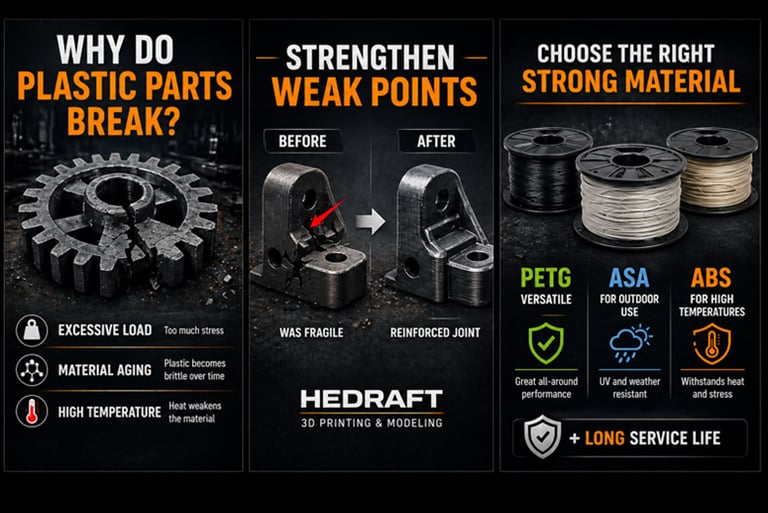
Why Plastic Parts Break: Causes and How to Prevent It
🔍 The main reason is that the plastic is pushed to its limits
Most plastic components are designed with the following goals in mind:
reducing production costs
reducing weight
mass production
👉 As a result, the strength is often just barely sufficient, rather than having a “safety margin.”
⚙️ 1. Mechanical Stress and Material Fatigue
The most common cause of failure is sustained stress.
This can include:
pressure
friction
bending
rotation
Over time, the material “gets tired”:
microcracks appear
strength decreases
failure occurs
👉 This is especially noticeable in gears, latches, and fasteners.
🌡 2. Temperature and Temperature Fluctuations
Plastic is highly sensitive to temperature.
Problems arise when:
the part heats up
or, conversely, is exposed to cold temperatures
Consequences:
the plastic becomes soft or brittle
it loses its shape
it cracks
👉 This often happens in cars and household appliances.
☀️ 3. Moisture and UV light
If a part is used outdoors:
sunlight breaks down the structure
moisture penetrates the material
cracks appear
👉 That’s why ordinary plastic quickly fails outdoors.
🧪 4. Material quality
Not all plastic is the same.
Manufacturers often use:
cheap blends
recycled raw materials
minimal quality control
👉 This accelerates wear and tear.
📐 5. Design flaws
Sometimes the problem isn’t the material, but the part’s shape itself.
For example:
walls that are too thin
weak spots in the fasteners
incorrect load distribution
👉 Breakage is inevitable in these areas.
🛠 Can failure be avoided?
Not entirely.
But you can significantly extend the service life.
What helps:
using stronger materials
reinforcing the structure
reworking weak spots
⚙️ How 3D printing solves this problem
Unlike factory-made parts, 3D printing allows you to:
✔ reinforce the structure
✔ eliminate weak spots
✔ adapt the part to real-world loads
👉 As a result, the new part often lasts longer than the original.
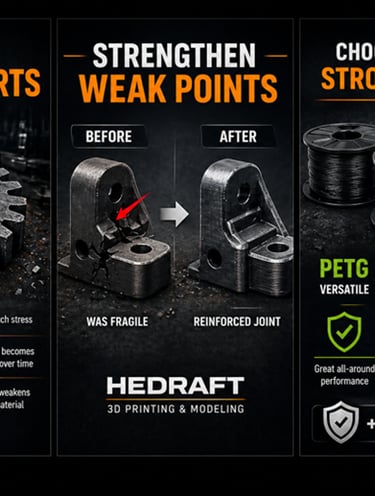
🛠 Real-world example
A classic scenario: a broken fastener.
Original:
thin plastic
breaks in the same spot
Solution:
👉 A repeat failure either doesn’t occur or is significantly delayed.
⏱ When to make a new part
It makes sense if:
the part has already broken
there is a weak spot
the original is unreliable
it is no longer available for purchase
📩 How to get a solution
👉 send a photo of the part to hedraft@gmail.com
👉 describe where it is used
You will receive:
an assessment of the problem
a material recommendation
a solution option
🔗 Conclusion
Plastic parts don’t break by accident.
The causes are almost always the same:
load
temperature
weak material
design flaws
But in most cases, this can be fixed.
A properly manufactured part can last longer than the original.
❗ When a part breaks, that's when the trouble starts
Almost everyone has been there: a small plastic part breaks—and the whole device stops working.
This could be:
a dishwasher
a refrigerator
a car
a tool
The problem is that:
the part you need isn’t available for purchase
the original part is expensive
delivery takes weeks
the model is no longer in production
And as a result, a perfectly functional appliance becomes useless because of one tiny part.
🔍 Why does this happen?
Most plastic parts are wear parts:
latches
fasteners
gears
guides
They are subjected to stress and wear out faster than other parts.
Manufacturers rarely sell them separately—they usually offer replacement of the entire assembly.
⚙️ Solution: 3D printing of the part
A modern approach: manufacturing parts from scratch.
How it works:
Part analysis (or based on a photo)
Creating a 3D model
Selecting the material
Printing and inspection
👉 The result is a finished part that fits perfectly and performs its intended function.
🛠 A real-life example
A common example is the wheels on a dishwasher basket.
Problem:
break quickly
sold as a set
are expensive
Solution:
install without modifications
👉 Repair in 1–2 days instead of buying new equipment.
⏱ Timeline and Cost
Typically:
Delivery time: 1–3 days
Price: lower than original parts
This is especially beneficial if the part is rare or needed urgently.
📩 How to order
To get a quote:
👉 Send a photo of the item to hedraft@gmail.com
👉 Include the dimensions (if available)
You will receive:
a feasibility assessment
material recommendations
timeline and cost
Conclusion
If a part breaks, that’s no reason to replace the entire device.
In most cases, it can be repaired faster and more affordably using 3D printing.