



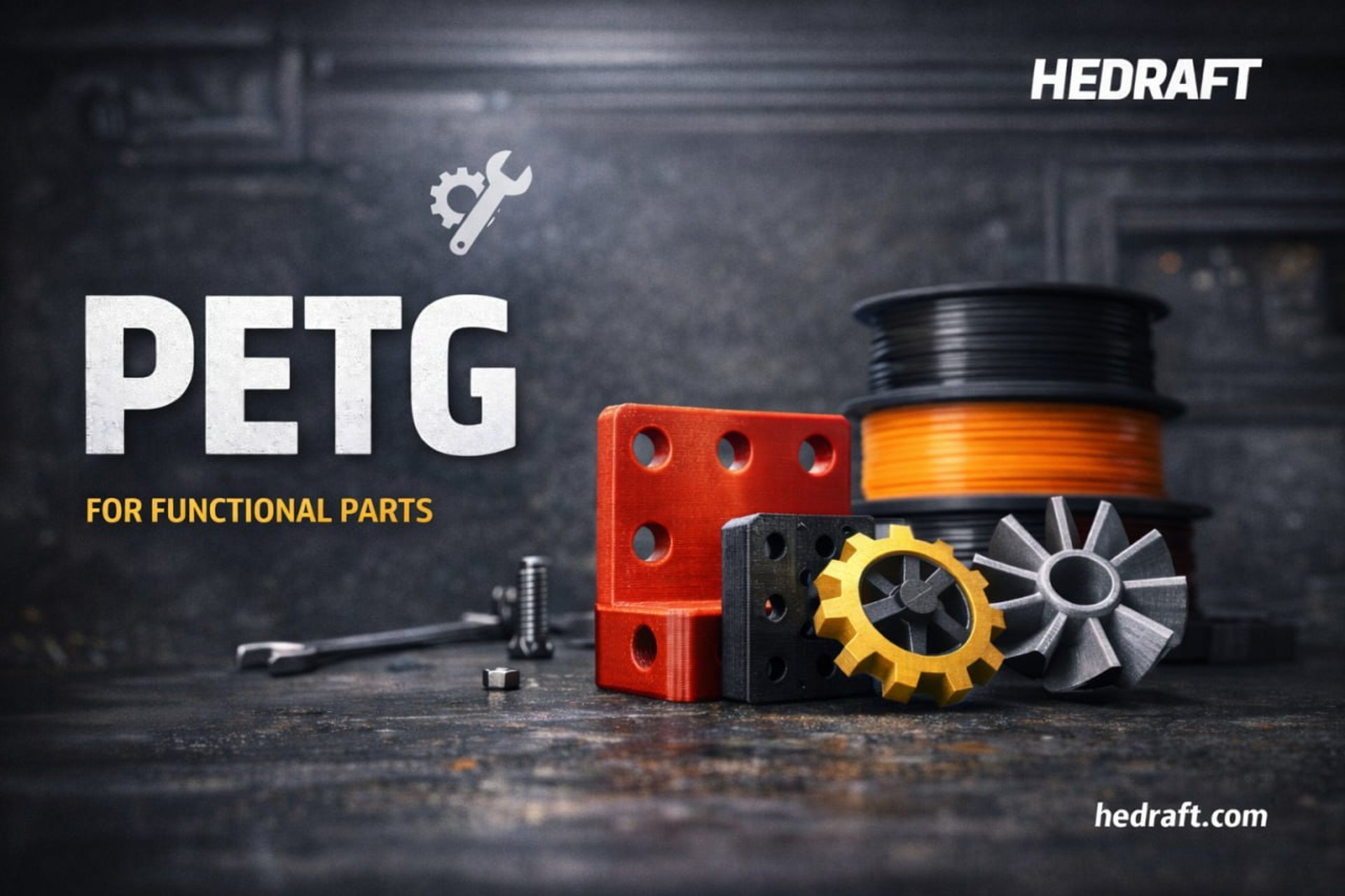
PETG
PETG is one of the most versatile materials for 3D printing functional parts. At HEDRAFT, we use PETG for fixtures, housings, brackets, and blanks where strength, moisture resistance, and dimensional stability are required. We work in Riga and throughout Latvia.
PETG is a versatile plastic for functional parts.
PETG is the material of choice when you need a "working" part: durable, non-fragile, and resistant to moisture and everyday use. It is the base material for most 3D printing jobs—from mounts and brackets to housings and repair parts.
Where PETG is suitable
Fasteners and brackets (for home/workshop/industry)
Appliance and electronics housings and covers (not exposed to high temperatures)
Appliance and household appliance repair parts
Parts for humid environments: kitchen, garage, basement (moderate)
Functional prototypes (already "working", not just in appearance)
Stencils and fixtures: holders, guides, templates
Parts for mechanisms for moderate temperatures
When PETG is not the best choice
Outdoor/constant UV exposure - ASA is better.
High temperature (near heating) - ABS/ASA/PA is better.
Power components with high loads and wear - PA/PAHT-CF is better.
Need maximum rigidity without "springiness" - PETG-CF is better.
Why choose PETG
Good strength and toughness: less brittle than PLA
Resistant to moisture and household use
Stable geometry for most standard parts
Versatility: suitable for spare parts and workpieces
Optimal price-performance ratio for both series and one-off orders
What we need to know before printing PETG
Where will the part be used: indoors/outdoors/in humid conditions?
Will there be warming (working temperature)?
Load type: static/impact/bending
Is perfect surface quality or a "technical look" important?
Are threads/bushings/metal inserts required? (If so, we will include a design consideration.)
Examples of PETG products
Brackets, fasteners, corners
Housings, covers, panels
Equipment repair parts
Holders, guides, fasteners
Frequently asked questions:
Is PETG suitable for functional parts?
Yes. PETG is one of the best general-purpose materials for processing parts such as mounts, brackets, housings, and repair parts at moderate temperatures.
Can PETG be used in humid environments?
What to choose: PETG or PETG-CF?
Can PETG withstand high temperatures?
Is PETG stronger than PLA?
PETG is versatile and "flexible". PETG-CF is stiffer and more geometrically stable, but may be less impact resistant. The choice depends on the load and mold requirements.
Yes, this is one of the options for devices for which PETG/PLA is no longer suitable in terms of temperature.
PETG withstands moisture and daily use well. For continuous outdoor use and UV exposure, ASA is more often recommended.
PETG is not the best choice for parts that are near heat sources. If there is heat, choose ABS/ASA or PA.