



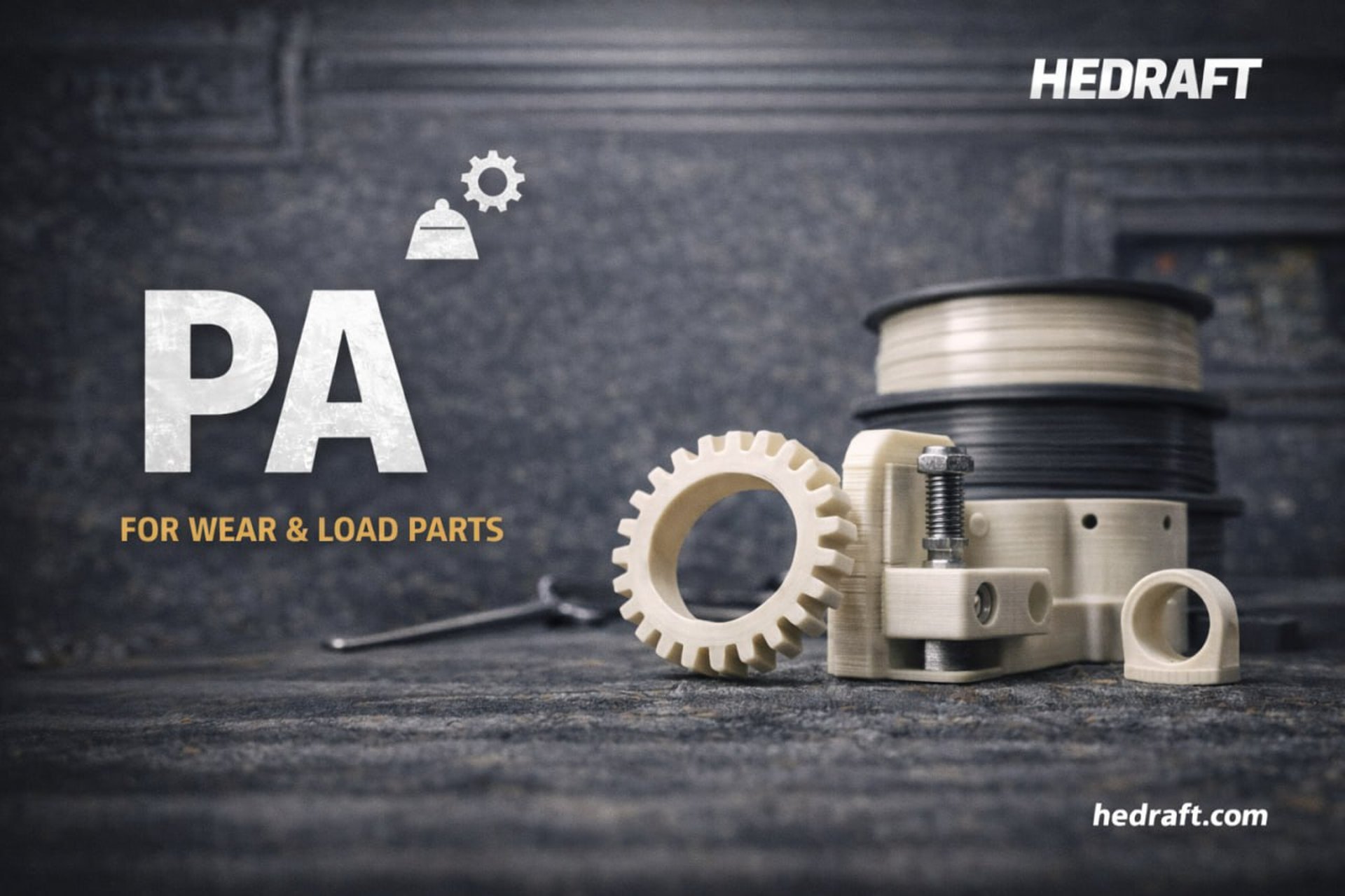
PA (Nylon)
PA (nylon) is an engineering material for 3D printing parts that operate under load and friction. At HEDRAFT, we use PA to manufacture gears, bushings, guides, and functional assemblies where strength, wear resistance, and longevity are critical.
PA (nylon) - wear, load and work mechanics
PA (nylon) is chosen when the part must withstand long-term use, including loads, friction and mechanical stress. It is the material for bushings, gears, guides and assemblies, where conventional plastics (PLA/PETG) quickly deteriorate.
Where is PA (nylon) suitable?
Bushings and sliding pads (in places where friction occurs)
Gears, rollers, guides (medium speeds/loads)
Load-bearing fasteners and structural elements
Working components of mechanisms: hinges, locks, latches (depending on the design)
Equipment parts: parts that must withstand use
Fittings and fasteners: stops, cams, holders
Functional parts subject to impact loads (depending on the application, PETG/PA is often better than PLA)
Parts for which stability and durability are important
When PA (nylon) is not the best choice
For outdoor use in UV exposure - ASA (or PA with protection/depending on application) is best
Maximum geometric stability without "play" is required - PETG-CF or PAHT-CF are most often used
High temperature resistance required - PAHT-CF (or other solution)
A perfect "shown" appearance is required - PLA is easier to use (when there is no load)
Why choose PA (nylon)
Wear resistance: withstands friction and mechanical stress well
Durability and longevity: less brittle than PLA
Suitable for parts that actually work, not just look good
Properly designed, suitable for bushings/gears/guides
What we specify before printing PA
Where and how the part works: load, friction, speed, cycles
Is there contact with oils/chemicals/water?
Are there any suitability/tolerances required (selected depending on the task)
Is a metal insert/pin/bush needed?
Conditions: indoor/outdoor/humidity
Is appearance important, or is durability and mechanics a priority?
Examples of PA products
Bushings, rollers, guides
Gears and transmission components
Load-bearing fasteners and assemblies
Repair parts for friction/load-bearing equipment
Frequently asked questions:
Is PA (nylon) suitable for gears and bushings?
Yes. PA is often chosen for bushings, gears and guides where friction occurs and wear resistance is required.
Is PA stronger than PETG?
What to choose: PA or PETG-CF?
Is PA suitable for impact-resistant parts?
Is PA "afraid" of moisture?
PETG-CF - stiffness and geometry. PA - wear and mechanics. If you need a rigid, friction-free part, use PETG-CF. If the part is working and rubbing, use PA.
Nylon can absorb moisture, so the right conditions and application are important. For outdoor UV-exposed parts, ASA is often the preferred choice, while PA is an excellent choice for indoor mechanical applications.
In mechanical applications, PA is often a better material in terms of strength and wear resistance. PETG is simpler and more versatile, but PA usually lasts longer under friction and stress conditions.
Often yes, because the material is durable. But the choice depends on the shape and load - sometimes PETG is better, sometimes PA, sometimes composite.
Is PA suitable for outdoor use?
In a permanently sunny location outdoors, it is better to choose ASA. PA is used outdoors locally and only when conditions require it.
When should you choose PAHT-CF over PA?
If higher temperature/load/stiffness and dimensional stability are required, then PAHT-CF.