



PETG-CF
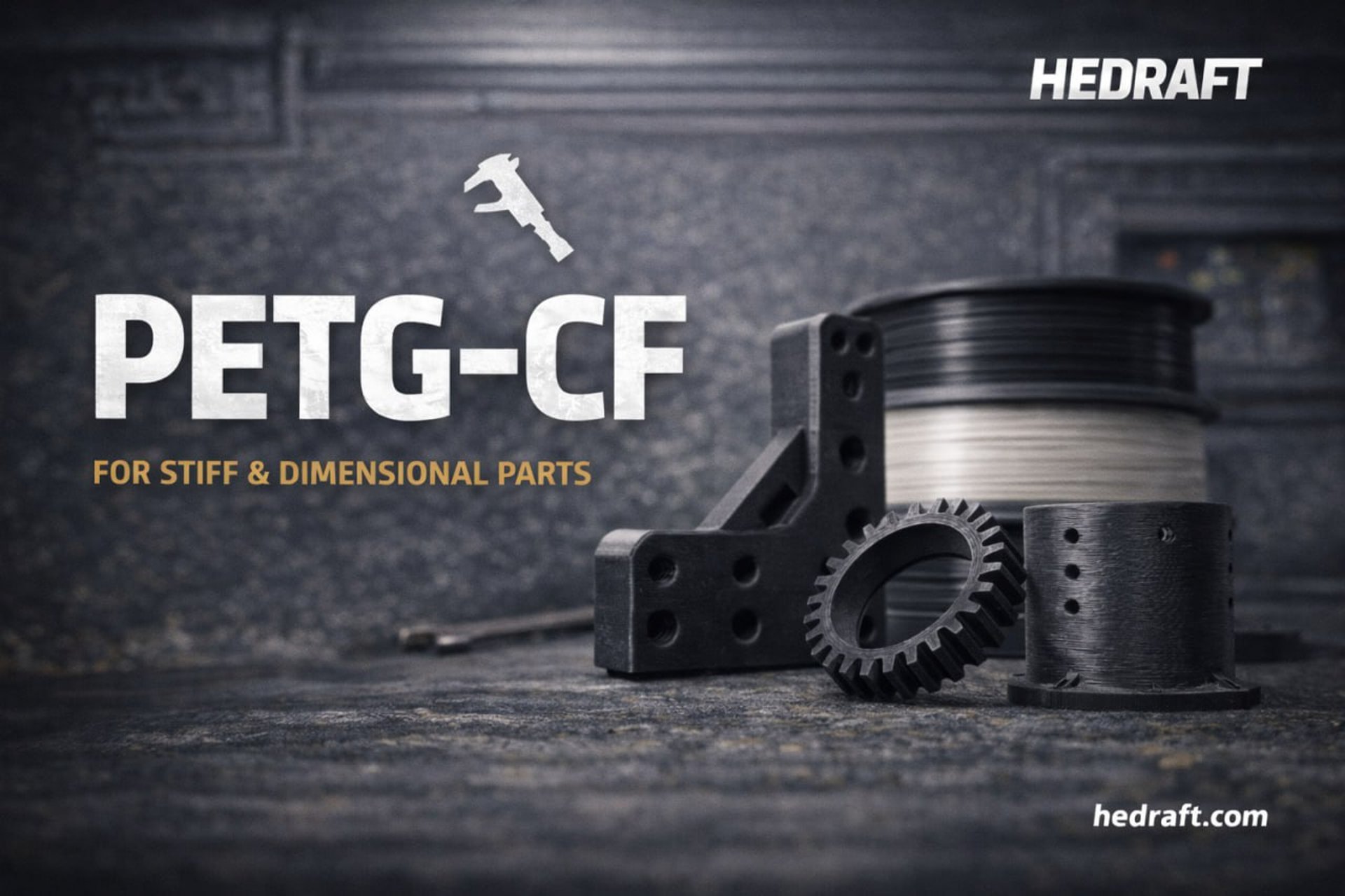
PETG-CF is a PETG-based composite material with added carbon fiber. It's suitable when increased rigidity and dimensional stability are required: the part will move less and maintain its shape better. At HEDRAFT, we use PETG-CF for technical fasteners, housings, and components where shape and precision are critical.
PETG – rigidity and stable geometry
PETG-CF is chosen for parts where standard PETG is too elastic, but rigidity and stability are needed. The composite holds its shape better and is suitable for structural components, brackets, and mounting parts.
Where PETG-CF is suitable
Rigid brackets and mounts (no impact load)
Parts with geometric requirements : landing, mating, guides
Housings and panels with minimal deformations
Technical elements of structures : ribs, reinforcements, racks
Equipment and fixtures : templates, holders, jigs
Serial products where dimensional repeatability is important
Parts that should not “spring” during operation
When PETG-CF is not the best choice
Strong impacts/drops - sometimes regular PETG is better (it is more “viscous”)
High wear and load - better PA / PAHT-CF
Street/UV permanent - better than ASA
High temperature near heating - ABS/ASA/PAHT-CF (as per the task)
Flexibility is needed – TPU
Why choose PETG-CF
Higher rigidity compared to PETG
Better geometric stability : less deformation on the part
Repeatability in a series and on large elements
Technical matte surface (often preferred by customers)
What we need to know before printing PETG-CF
The part will experience impact or only static load
Are precise fits and tolerances required?
Where used: indoors/outdoors
Is there heating?
Are metal inserts/threaded bushings required (if fastening unit)
Examples of PETG-CF products
Reinforced brackets and fasteners
Housings, panels, mounting elements
Equipment, conductors, holders
Parts where shape and rigidity are important
Frequently asked questions:
Is PETG suitable for functional parts?
Yes. PETG is one of the best general-purpose materials for processing parts such as mounts, brackets, housings, and repair parts at moderate temperatures.
Can PETG be used in humid environments?
What to choose: PETG or PETG-CF?
Can PETG withstand high temperatures?
Is PETG stronger than PLA?
PETG is versatile and "flexible". PETG-CF is stiffer and more geometrically stable, but may be less impact resistant. The choice depends on the load and mold requirements.
Yes, this is one of the options for devices for which PETG/PLA is no longer suitable in terms of temperature.
PETG withstands moisture and daily use well. For continuous outdoor use and UV exposure, ASA is more often recommended.
PETG is not the best choice for parts that are near heat sources. If there is heat, choose ABS/ASA or PA.