



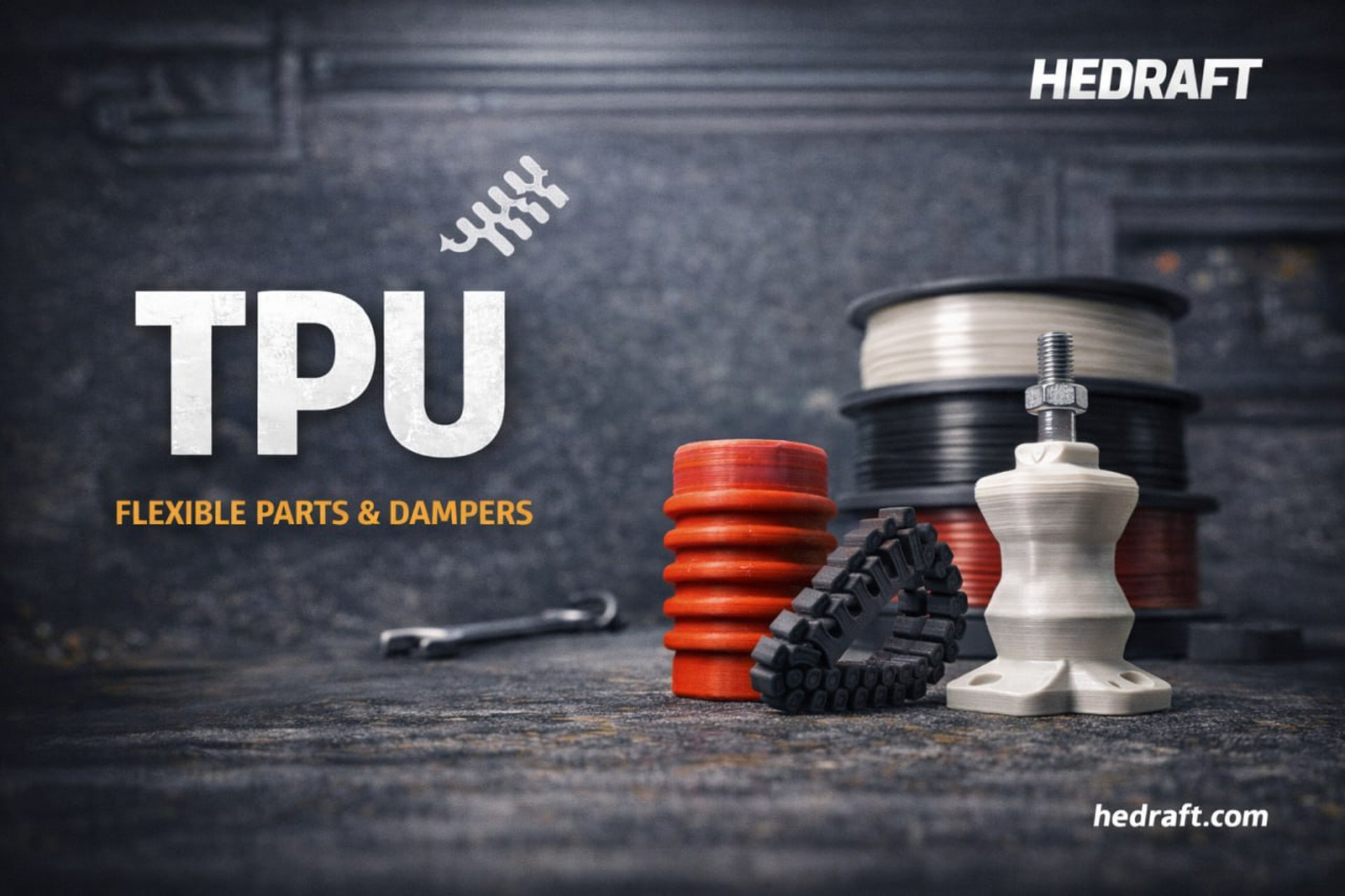
TPU
TPU is a flexible 3D printing material with a rubber-like behavior. At HEDRAFT, we print TPU shock absorbers, pads, seals, and protective elements where flexibility, shock absorption, and wear resistance are needed.
TPU – flexible parts, dampers and seals
TPU is chosen when a component must flex, absorb shock, and resist cracking from impacts. It is used for dampers, feet, pads, seals, and protective elements where rigid plastics are unsuitable.
Where TPU fits
Dampers and shock absorbers (vibration and shock absorption)
Legs, stops, anti-slip elements
Overlays and protective parts (surface, edge, and body protection)
Seals and gaskets (as required, under suitable conditions)
Flexible holders and fasteners (clips, latches with elasticity)
Tool covers/covers (grip comfort, protection)
Elastic connectors and bushings
Parts where “non-fragility” when impacted/dropped is important
When TPU Isn't the Best Choice
High rigidity and geometry are required – PETG / PETG HF / PETG-CF are better
Heavy loads and wear in mechanics - better PA / PAHT-CF
Constant Street + UV — we often choose ASA (or solve it according to the problem)
Heat resistance near heating is required - ABS/ASA/PAHT-CF
Why choose TPU?
Flexibility and shock absorption : the part works like rubber
Impact resistance : does not crack like hard plastics
Comfort and protection : anti-slip, softening, surface protection
Good for functional "soft" elements in assemblies
What we check before printing TPU
What should the firmness/elasticity be (soft/medium/hard)
Will there be contact with oils/chemicals/water (important for selection)
Operating temperature: is there heating?
Load: compression/tension/bending/friction
Geometry: Are there thin walls and how will the part be mounted?
Is a precise fit required or is a little “elasticity” acceptable?
Examples of TPU products
Dampers, vibration mounts, shock absorbers
Legs and anti-slip stops
Gaskets and seals (depending on conditions)
Covers/covers/protective elements
Flexible fasteners and clips
Frequently asked questions:
Is TPU "rubber"?
TPU is not rubber, but it behaves very similarly: it bends, absorbs shock, and does not break like hard plastics.
Is it possible to print a seal from TPU?
Can TPU be used outdoors?
Is TPU suitable for parts that will be constantly rubbing?
TPU is wear-resistant, but under high friction/load conditions, the choice of material depends on the conditions. Sometimes PA is better, sometimes TPU, and sometimes a combination of both.
Yes, but it's important to understand the conditions: temperature, contact with liquids, pressure. We'll suggest the right shape and material for the job.
Yes, but long-term UV exposure and weather conditions depend on the specific TPU and conditions. For strictly "outdoor" rigid parts, we usually use ASA.
What to choose: TPU or PETG?
PETG is for rigid, functional parts. TPU is used when flexibility, shock absorption, and anti-slip properties are needed.
Is TPU suitable for clips and latches?
Yes, if you need a flexible latch. But we design it taking into account the TPU's ability to "flex" and require proper geometry.